
Insights · October 22, 2026
Foothill Power Is Hard on Your Home. Here's What It's Doing to Your Equipment.
By Chris Worthington · Personal Technology, Alhambra
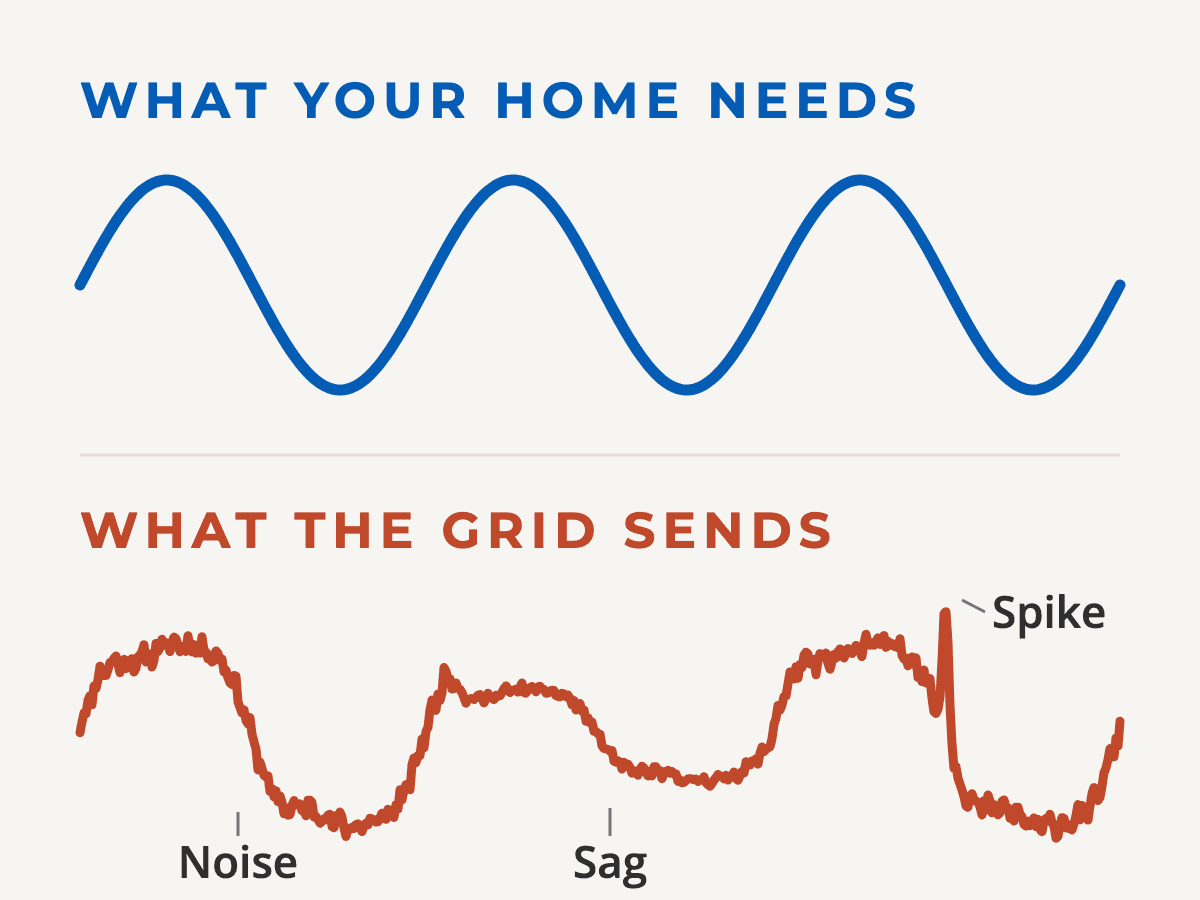
Ask anyone in La Cañada Flintridge, Altadena, Sierra Madre, or the Glendora foothills about their power and you'll hear the same stories: the blinks when the wind comes up, the public-safety shutoffs in fire weather, the clocks that need resetting after a stormy night. Those are the visible events. The invisible ones — the sags, spikes, and electrical noise riding the line on perfectly calm days — are what quietly shorten the life of everything expensive in the house.
The grid works hardest where you live
Foothill neighborhoods sit at the ends of long distribution runs through terrain that utilities de-energize in high winds precisely because it's hazardous. Every switching event, every reclose after a fault, every shutoff and restoration sends transients down the line. And between events, demand swings and the sheer length of the feeder mean voltage arrives less steady than the equipment in your home was designed for.
This isn't speculation — it's now measured at scale. Whisker Labs operates Ting, a network of more than a million sensors plugged into American homes, each sampling household voltage millions of times a second. Their maps show wildfires, storms, heat waves, and even solar storms sending sags, spikes, and distortion across whole regions — including homes that never lose power (source: tingfire.com/impact). In one 2024 study of that data, 36.5% of homes in a major utility's territory received power with harmonic distortion above the 8% limit in the IEEE 519 standard, and the May 2024 solar storm pushed distortion as high as 25% in places (source: tingfire.com's analysis of total harmonic distortion on the U.S. grid). Distortion like that overheats motors, compressors, and transformers and shortens their life.
What it costs you
Almost everything in a modern home runs on a circuit board: the refrigerator, the range, wine storage, HVAC, pool equipment, the washer and dryer, lighting control, the network. Dirty power rarely kills them dramatically. It shows up as flicker, resets, error codes, a compressor that fails years early, a control board that costs four figures to replace in an appliance that's otherwise fine. The damage is cumulative and the invoice arrives one appliance at a time.
Why your generator or battery doesn't solve this
A standby generator or home battery answers one question: what happens when the grid goes down? It steps in during an outage. The rest of the time — which is nearly all of the time — grid power flows straight past it to your equipment, spikes, sags, and noise included.
A power quality system answers a different question: what is the house running on right now? It sits between the grid and your home and cleans every watt, every second, whether the grid is up or down — and its built-in storage means a shutoff begins without so much as a flicker. It's an addition to backup power, not an alternative: the generator or battery carries the house through the long outage, and the power quality system makes sure whatever reaches your equipment is clean, whatever the source.
Sized to the home
Protection comes in three sizes: plug-in units for a single critical spot like the equipment rack or home office; breaker-level systems wired into the panel to protect chosen circuits like refrigeration and wine storage; and whole-home systems — RoseWater Energy's HUB platform — that put nearly every outlet and appliance on clean power, up to 200 amps. Our Power Quality page has an interactive planner: pick the systems in your home you'd least want to lose, and it recommends the right level.